
If you are in debt, it might feel like you will never get out from under that mountain of debt. According to some financial experts, there’s one way for you to make your debt-free journey a bit easier and faster. It is referred to as the debt snowball method and it is meant to help those who get into the habit of paying their debts.
The Debt Snowball is when you pay off the credit cards with the least amount of total dollars first. Then you pay off the next least dollar amount debt next. The Debt Avalanche is where you pay off the debt with the highest interest rate percentage first to save you money. Then you work your way down to the next highest percentage debt till you get to the end of your debt.
Debt Snowball vs. Debt Avalanche
The Debt Snowball
With the debt snowball method, you can pay off your debt starting from the smallest to biggest balance no matter what the interest rates are. Oftentimes, people have lots of small debts lying around.
Many statements come every month and several minimum payments can be overwhelming to pay. The bills of doctors from various places, small balances on store credit cards, and money borrowed from your family members can be a little frustrating.
When you start with the smallest debt, and pay extra each month to the principle, you will knock out that debt quickly.
How to Quit Your Job with Passive Income
Get the Best Selling Book FREE!

Then you move on to the next smallest debt and take the amount you were paying to the first debt and pay that additional amount to the next debt.
Once you pay debts from your smallest to biggest balance, you will be able to clear these debts away quickly.
Depending on your financial situation, you can be able to get rid each of your debt on a monthly basis for the first few months.
This will let you feel empowered as you see quick progress and you become successful in paying off the debts one by one. By the time, you tackle bigger debts, you will have the ability, confidence, and additional cash from the previous payments to pay all your debts off completely.
The Debt Avalanche
On the other hand, when it comes to the debt avalanche method, you have to pay the debts starting from the ones with high-interest rates to the lowest one. It makes sense for many people since you’ll pay less in interest once you tackle your debts by order.
You do this in order to save yourself spending extra money on interest as you knock away the debts one by one with the largest interest.
You can also save money on the interest rates. Aside from that, you will get the most out of your money once you choose to get rid of your debts with high-interest rates.
What is the Debt Snowball Method?
As mentioned above, the debt snowball method will let you focus on paying off your account with the lowest balance and pay the minimum payments every month.
Once you have disposed of all of your smallest debts, you can now move to another smallest balance until you tackle the biggest one.
Here is an example:
- Pay an extra $50 to the debt of credit card A that has $500 in debt and $55 a month minimum payment.
- Once that debt is paid off, then you have another $105 from that payment that you can then start paying toward the next smallest amount.
- Pay an extra $105 each month to credit card B that has a balance of $1,300 with a minimum payment of $68.
- Once that debt is paid off, take both of these payments ($173) and pay the next largest credit card.
- Pay an extra $173 each month to credit card C and pay that debt off.
- Keep going until all the debts are paid off.
This method enables you to begin with quick wins and boost your confidence, allowing you to recharge your motivation and avoid debt fatigue.
You can get rid of your first debt in just a few months, which will make you feel good.
The tradeoff is that you might be vulnerable to huge interest charges on some accounts.
What is the Debt Avalanche Method?
With the debt avalanche method, it takes discipline and patience to succeed.
Rather than focusing on the smallest balance, this method will encourage you to start with debts that have high-interest rates.
You only make minimum payments to others. This approach can help you pay off debts faster at low cost since you will be decreasing your interest charges.
Here is an example:
- Pay an extra $50 to the debt of credit card A that has a 23% interest rate in debt and $55 a month minimum payment.
- Once that debt is paid off, then you have another $105 from that payment that you can then start paying toward the next smallest amount.
- Pay an extra $105 each month to credit card B that has an interest rate of 18% with a minimum payment of $68.
- Once that debt is paid off, take both of these payments ($173) and pay the next largest credit card.
- Pay an extra $173 each month to credit card C with an interest rate of 12% and pay that debt off.
Keep going until all the debts are paid off. For some people, this method can be more difficult to see progress if high-interest rates are the bigger debts that might take much longer to clear away.
For you to stay on payoff track, see to it that you have set aside an emergency fund to deal with your surprise expenses.
Is the Debt Snowball the Best Method for Paying off Debt?
Debt snowball works since it revolves around behavior modification. Once you begin paying on your student loan first since it is the biggest debt, you will not be able to get rid of it for a while.
You will see some numbers going down the balance, but you might begin to lose steam and stop paying the extra.
The reason behind it is that you might feel that paying the debt may take forever and you still have other small debts hanging around.
However, what you should know is that once you do something with consistency, you’ll see results.
Paying smallest debts first will help you pay off your debts quickly since you will always have hope every time you are done paying every small debt you have.
If you see that this method works, you will feel like you can do it and you will succeed to be free from debts.
How to Quit Your Job with Passive Income
Get the Best Selling Book FREE!
When the time comes that you have to pay the bigger debts, you have more cash freed up from paying off the smaller ones that it makes a debt snowball.
Then, you will put hundreds of dollars monthly toward your debts rather than chipping them away with minimum payments.
You create momentum and this changes your behavior and will help you get out of debts for good.
How the Debt Snowball Method Works
Just think of a snowball rolling down a mountain at a high speed. It begins with a small size, but as it rolls down, it becomes bigger and gains momentum.
Once the snowball reaches the hill’s bottom, it becomes a boulder. It’s the theory you can apply when paying off your debts. You will begin small with focused intensity.
In the long run, you will gain momentum. You might even surprise yourself on how fast you crush debts after debts on the way down.
The debt snowball method is simple, but you have to understand it well for you to achieve success. You may begin with getting a sheet of paper and listing all of your debts from the smallest to biggest.
In this method, you don’t need to worry about the interest rates as you have to focus on the amount of your debt.
Make small payments on debts except the smallest ones that must be your number one priority. Then, attack your smallest debts with vengeance.
Do your best to get rid of them. You can take a part-time job or start your own business to earn more money.
Focus On Eliminating the Debt and Don’t Give Up
You can do whatever you want as long as it will help you eliminate your first debt on the list.
Once you pay off your smallest debts, you can add your freed-up money to pay off another small debt until you reach your biggest debts.
You have to work hard on a second debt as you continue to pay the least payments on the rest of the debts.
Once you are free from your second debt, do the best you can. Send the money to the other debts on the list. Continue with the process until you have crossed off all debts and you are complete debt-free.
Just imagine all the money goals you will be able to conquer once you pay off your debts.
Snowball Method Step-by-Step
How do you use the debt snowball method, then? There are four simple steps involved in the debt snowball method:
- List out all of your existing debts but don’t include your mortgage. Sort these debts in order from the smallest up to the biggest balance.
- Pay the least amount on every balance on a monthly balance except the smallest debt. Put the most amount of money you can on your smallest debt.
It is best to go through your budget and determine the amount you can place on the smallest balance without compromising other areas of your finances. - Once you finished paying off your smallest balance, you can roll the extra cash you once used for that balance to the monthly payment for your next smallest balance.
Don’t forget to continue putting the minimum payments on the rest of your debts. - Repeat the process until you are completely free from debt.
There are several benefits associated with the debt snowball method. The main advantage of this method is none other than the psychological boost.
The moment you see your debts disappearing little by little, this will boost your motivation to pay off your debt continuously.
And even when you just paid off the least balance, your confidence level is going to grow as you witness the progress you are making.
This method can also help you be in better control of your finances and your stress levels.
When you focus on just a single debt balance at a time, the snowball method frees you from worries on how to deal with your debts at once.
Should I Pay Off Smallest Debt First?
The main reason why the debt snowball pays off the smallest debt to the largest is that it is more important to modify your behavior and provide inspiration to be debt-free than the math.
The possibility of becoming wealthy is influenced more by your behavior instead of your academic pedigree or financial sophistication.
By paying off the smallest debt, you will experience success and this will give you hope. After that, you move on to your next debt.
Once you pay this next debt off, you will be free from two debts. This knowledge will energize you and motivate you to keep going.
This is the point where you start feeling excited and you start believing in yourself more.
The thought that you are now on your road to being debt-free drives you to do better and better.
How Will the Debt Snowball Affect Your Credit?
Once you have finished paying down your debts, you will have more cash available every month that you can either save or spend as you want.
When you practice the debt snowball method, you can also start building your credit.
It will then help you get better interest rates when you apply for a personal loan, a vehicle business, or a mortgage.
The debt snowball method is especially great for consumers who are using several credit cards that have outstanding balances.
In case there are small balances in your credit card accounts and you are starting to get annoyed paying them every month, the debt snowball method will suit you.
Pro Tip: One trick to boost your credit even more quickly is to NOT cancel your credit cards. The reason why is that credit companies look at how much available credit you have that you are not using.
Banks like it when you have a lot of available credit but very little of the credit being used.
Personal Example: Credit Drop 100 Points
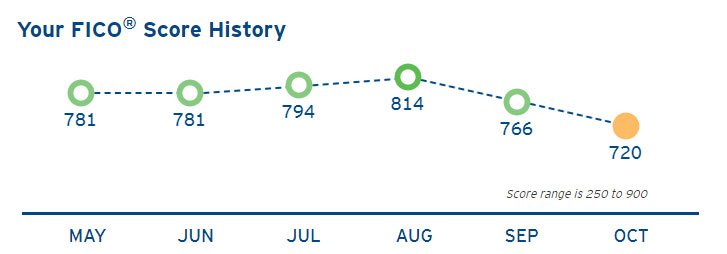
I personally have built my credit up to 815 which is very good. Recently I canceled 3 cards because I was tired of having these cards laying around.
After I canceled the cards, without doing anything else, my score dropped by 100 Points…
THEN!
My Credit Score Went UP!
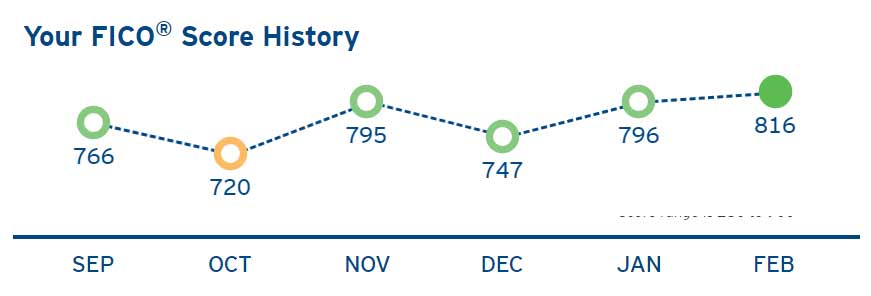
After this crash, I opened up 3 more cards.
These three cards had a total of $35,000 credit limit. Even though I’ll most likely not use that much money ever, it helps my credit score.
With these new cards and higher total credit available, my credit jumped back up.
Not just back up to where it was but Higher than it was before!
Other Benefits of the Debt Snowball Method of Paying Off Debts
You will also feel better because you know that your cash goes toward outstanding debt every month. Start saving for your future instead, contribute to retirement funds, and develop an emergency fund.
You will own your money all over again and this can be a quite satisfying feeling.
This technique is also a great psychological boost for those people who are starting to feel discouraged because of their debt and are worried about high maintenance payments.
The method has been designed to help you enjoy results right away as you pay off your debts. This also appeals to people who tend to get upset or disheartened easily.
The effect of the debt snowball will continue to roll until you have paid off all your credit cards. Thanks to this method, you will enjoy the regular successes of paying off your credit cards during the process.
It means that you will feel more encouraged as you repay even when you might need to pay higher interest rates in the future.
Example of How the Debt Snowball Works
To understand how the debt snowball method works, here is an example, Assume that you got several outstanding loans.
Your budget every month gives you an extra $100 every month available for additional loan payments. How should you use this money?
First, list all of your loans or credit card debts starting from the smallest to the largest balance.
- Personal loan – $2,000 balance, 7% rate, $39.60 minimum payment
- Private student loan – $13,000 balance, 5% rate, $183.74 minimum payment
- Credit card – $16,000 balance, 17% rate, $480 minimum payment
- Auto loan – $21,559 balance, 4.75% rate, $404.38 minimum payment
Based on debt snowball, the extra $100 every month should go first to the personal. It means that you will pay $139.50 to the lender every month, the sum of the extra $100 and the required payment of $39.60.
Once you have paid off every loan, the payment of the loan will become available for the other debt payments.
- Once you paid off the personal loan, you have an extra $139.60 for your next loan since you no longer need to pay the lender of your personal loan.
- You will pay additional money every month to the provider of your student loan. This payment is the required $183.74 with the additional $139.6 that is equivalent to $323.34.
- When your student loan is paid off, you will have an extra $507.08 available every month to pay off your credit card.
- This process will continue building momentum until all your debts have been paid off.
With this process, you can pay off mountains of debt in a short time.
Just get started today doing the debt snowball and start to live life on your own terms.